An OC high school senior helps adults and youth understand each other post-pandemic.
Years after the COVID-19 pandemic closed schools and pushed life behind screens, 17-year-old Taylor Fingersh thinks one thing didn’t fully recover: people’s patience with each other.
In Ladera Ranch, Fingersh is working to rebuild those connections between young people and adults through storytelling, community service and in her role as a student representative on the Capistrano Unified School District board, which represents approximately 46,000 pupils.
“There was a lack of respect going both ways [during the pandemic], and I think that has been very detrimental to the connection between teachers, students, adults, children and community members,” said Fingersh, a senior at Capistrano Valley High School.
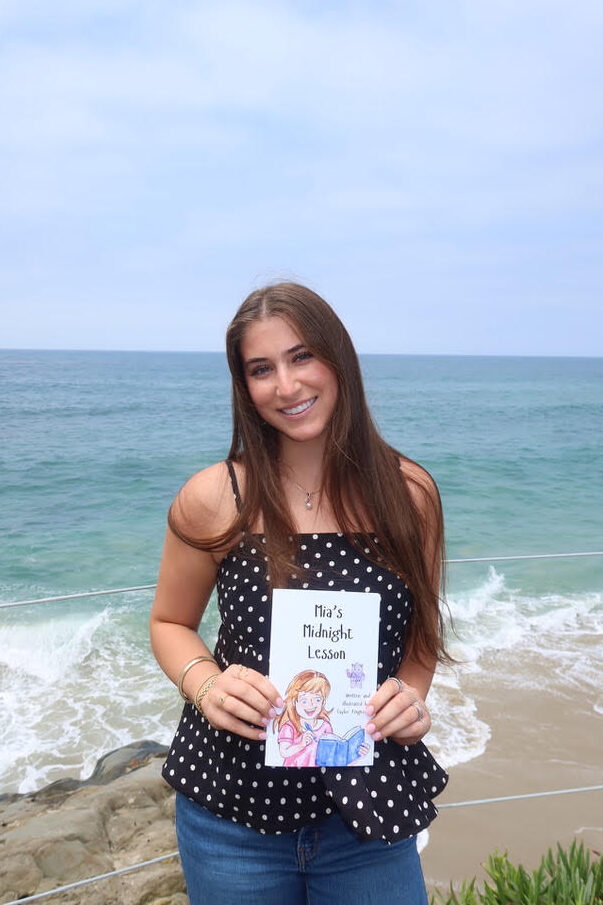
Her latest project to address this disconnect is “Mia’s Midnight Lesson,” a book she wrote and illustrated as part of her Girl Scout Gold Award to help children and adults understand that making mistakes is a normal part of growing up.
The story follows Mia, a third-grader who struggles with impulsively taking toys from her classmates and having nightmares out of guilt and anxiety. The story introduces ideas about honesty, accountability and decision-making in an accessible way for younger children.
The book also includes discussion questions and an author’s note that explains the developmental concepts woven into the book, informing parents about the science behind their children’s behavior. Fingersh’s story emphasizes the importance of understanding youth impulsivity, validating kids’ emotions and creating supportive environments where they feel safe admitting to their mistakes.
“Parents may not remember what it was like to be a 10-, 11- or 12-year-old struggling with their emotions and puberty and everything,” Fingersh said. “And most kids at that age don’t quite know how to voice their needs in a respectful manner.”
Fingersh has since read the book to more than 520 children at Girl Scout camps, local YMCA programs and elementary schools. She donated 120 copies to classrooms and families, and her high school has incorporated the book into its advanced psychology curriculum.
When Fingersh was 8, her family went through the foster-adoption process for her younger brother, sparking her interest in childhood development and the importance of a stable home environment.
Those experiences were reinforced in high school through psychology courses and later through an internship with the Orange County Superior Court’s Young Adult Court program, where Fingersh learned about youth brain development and the criminal justice system.
“The human brain is not fully developed until 25,” Fingersh said. “That is always something that adults should keep in the back of their mind when they’re figuring out how to navigate bad behavior, impulsivity and bad interactions with their children and those in their community.”
As a Capistrano Unified student representative, Fingersh has hosted monthly roundtables for students, families and administrators to discuss concerns like academic pressures and school transitions directly with district leaders.
This semester, Fingersh is applying to colleges and plans to major in public policy or pre-law while minoring in psychology. She aims to work in children’s advocacy.
“I will always be an advocate for positive reinforcement and patience,” she said.
By Vanessa Arredondo