Anaheim teen’s nonprofit works to educate families about childhood myopia.
Camden Niknam’s mission started as a young child when he sat very close to the TV because he couldn’t see.
“I did not understand why,” said Niknam, 17, of Anaheim, a senior at Canyon High School.
He was diagnosed with myopia (nearsightedness) at age 3. The prescription for his glasses began at about -0.50 diopters and eventually reached about -7.50.
“Each year, my glasses seemed to become thicker and heavier,” he said.
As his prescription worsened, Niknam wanted to learn more about why this was happening. He found some information gaps and other challenges when it came to childhood myopia. He founded Clarity Reach about two years ago with the intention of bridging some of those gaps.
“I realized that other children did not necessarily have to go through the same uncertainty I had,” he said.
Clarity Reach began by creating and distributing educational flyers to local schools. The work expanded into research, a website (clarity-reach.org), expert interviews, outreach, advocacy and Clarity Reach was approved as a 501c3 nonprofit on July 23.
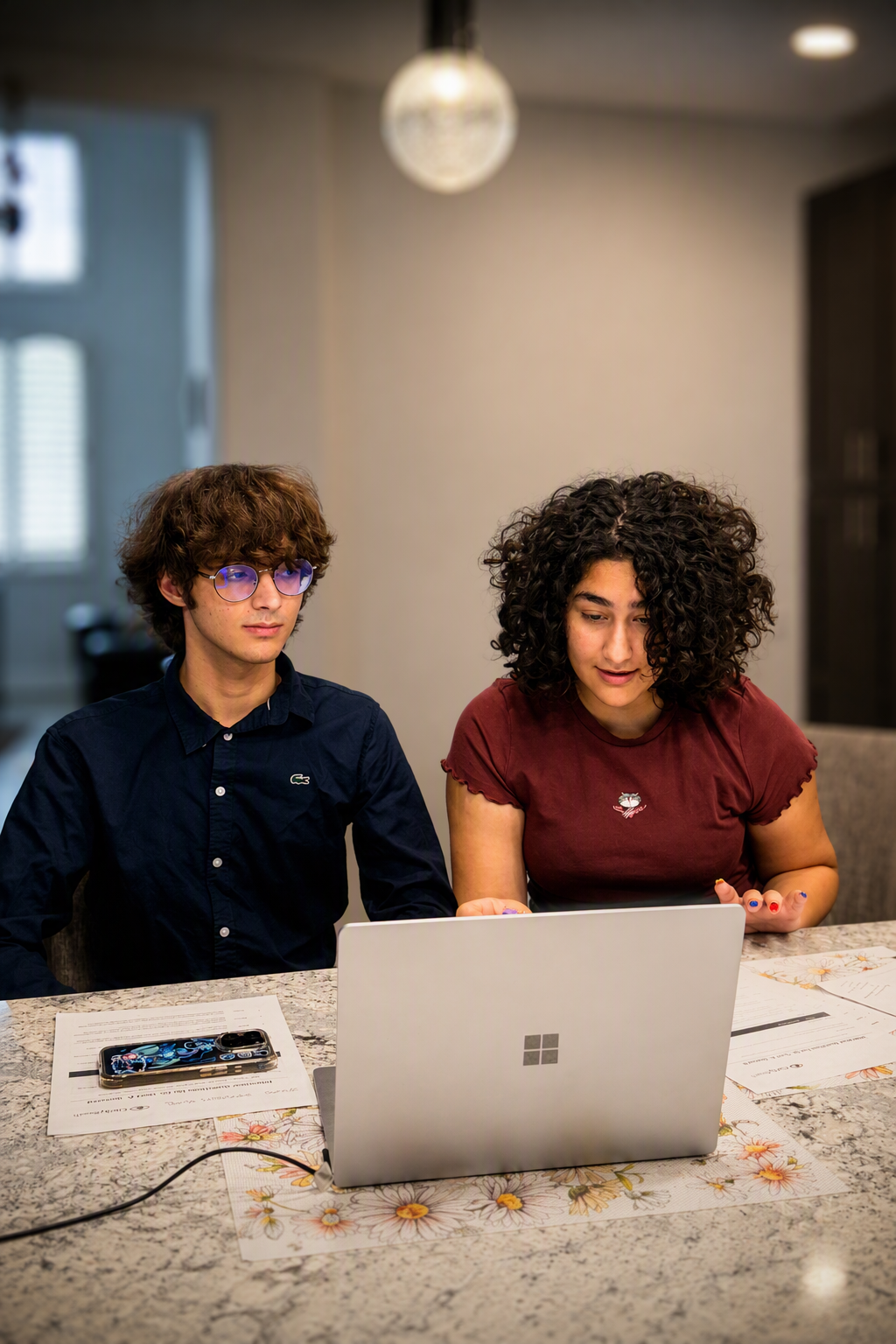
Niknam, whose career goal is becoming an ophthalmologist, leads most of the organization’s direction, research, interview preparation, outreach and public education. His sister, Donya, a second-year Neurobiology, Physiology and Behavior major at the University of California, Davis, is co-founder and works with him on research, interviews and content. She helps with scientific topics, which can be highly technical.
Their father also has an engineering background and is experienced with statistics. He encouraged them to study what parents actually know about childhood myopia, which helped inspire Project LENS, the Learning, Education and Nearsightedness Study.
“We have also received guidance from experienced researchers and learned from the clinicians, scientists, educators and public-health leaders who have shared their expertise,” Niknam said.
Expert interviews have been at the center of Clarity Reach. Niknam and Donya have done about 23 expert interviews — selected based on the questions families need answered, gaps in public understanding and the expert’s ability to explain a clinical, research, education or public-health perspective.
Many interviews are done remotely, but he has traveled — including to China. Niknam became interested in how other countries respond to the growing prevalence of myopia, especially China’s approach. He and his family spent 25 days in China, interviewing doctors and researchers in Beijing and Shanghai.
“In China, I learned about clinical approaches being used or studied there as well as public policies encouraging children to spend more time outdoors and take regular breaks from prolonged ‘near work,’” Niknam said. “The experience showed me that childhood myopia can be addressed at both the clinical and policy levels.”
They are also scheduled to travel to Massachusetts to interview Nobel laureate Sir Richard Roberts, an expert in gene splicing. Though he is not a myopia expert, the interview is part of a broader educational idea Clarity Reach is developing through an initiative called KNOW WHO — “You know WHAT. Now know WHO.”
“Students learn about concepts such as introns and exons, mRNA, artificial intelligence and CRISPR, but often know little about the people behind major discoveries,” he said. “Our goal is to introduce accomplished scientists and innovators to younger audiences without overwhelming them with highly technical material. We will keep our primary focus on myopia and eye health while exploring subjects that connect to genetics, medicine, technology and science education.”
By Jessica Peralta