
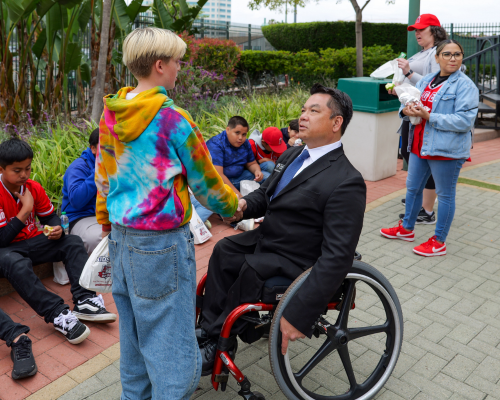
Q&A with Orange County Superintendent of Schools Stefan Bean about AI, mental health and the new school year.
Parenting OC: Looking back at the 2025-26 school year, how did it go?
Stefan Bean: I would describe this as a year of reflection, resilience and progress.
As I shared during our State of Education address in March, Orange County schools are serving students with increasingly complex needs while also navigating challenges like declining enrollment, financial pressures and rapid changes in technology. But despite those challenges, I continue to be inspired by what I’m seeing across our schools and communities.
One of the biggest takeaways this year is that student well-being and academic success really do go hand in hand. During the State of Education, we talked a lot about school connectedness, student safety and mental health — and the idea that no one gets there alone. While we’ve seen encouraging progress in some areas, we also know too many students still feel isolated or overwhelmed. That’s why we are focused on creating schools where every student feels safe, supported and valued.
I’ve also been encouraged by the collaboration happening across Orange County. Districts are strengthening literacy, expanding career technical education opportunities and approaching artificial intelligence in thoughtful and responsible ways.
More than anything, this year reinforced something I believe deeply: Student success is built through relationships, support and people continuing to show up for one another. Again, no one gets there alone.
POC: What goals were met and which were not?
SB: So, one of the most important things we did recently at OCDE was bring our program leaders together to develop specific key performance indicators aligned to our 5-3-1 Strategic Plan. That work gives us a much clearer framework for measuring progress and organizational impact moving forward.
Because many of those indicators are new, next year will give us a more concrete opportunity to evaluate growth against those benchmarks. But even now, we can point to important signs of progress across Orange County.
Chronic absenteeism is down, and Orange County students continue to outperform the state in math, English language arts and science. We’ve also seen encouraging movement in school connectedness and in the number of students reporting they feel safer on campus.
At the same time, we know there is still a lot of important work ahead. Not all student groups are experiencing the same outcomes or opportunities. Too many students are struggling with anxiety, isolation and mental health concerns. As we discussed during the State of Education, nearly one in three students reports being bullied or harassed, with the highest rates reported among some of our most vulnerable student groups.
What gives me optimism is that we are approaching these challenges with greater clarity, stronger alignment and a shared commitment to continuous improvement on behalf of students.
POC: What are the key goals for the next school year?
SB: Our planning is really being guided by two things: a clearer understanding of student needs and a stronger commitment to measurable outcomes.
As I mentioned, we now have specific key performance indicators tied to every part of our 5-3-1 Strategic Plan. That gives us a much more intentional way to measure our impact across areas like literacy, career technical education, emotional intelligence, school safety, chronic absenteeism and artificial intelligence.
I’ll give you a few examples. One of our goals is making sure districts are equipped with effective strategies to reduce chronic absenteeism. Another focuses on increasing career technical education pathway completion across every student group by 5 percent. We also want at least 75 percent of educators and students participating in AI initiatives to strengthen their ability to use these tools responsibly and effectively.
We are really entering this next school year with greater alignment as an organization. We have clear goals, strong partnerships and a shared understanding that continuous improvement is really about creating better outcomes and opportunities for students.
POC: Obviously AI and mental health are still big issues. Can you talk about plans in these areas?
SB: Well, you’ve really touched on two of the biggest issues facing education right now, and I think both require thoughtful, balanced approaches.
When it comes to AI, our focus isn’t just on adopting new technology for the sake of it. It’s about using it intentionally, thoughtfully and responsibly. Through our 5-3-1 Strategic Plan, we’re working with districts to support professional learning, protect student data and help students build the skills they’ll need in a rapidly changing world. But we also want to make sure human relationships and sound judgment stay at the center of education.
Here’s one thing we’re doing that we haven’t yet shared publicly. We’re bringing a group of superintendents together to help shape thoughtful, human-centered approaches to AI across Orange County. We want this to be a space where district leaders can learn from one another, share what’s working and wrestle honestly with challenges.
Mental health is another area that must remain a major priority, especially in an age so heavily influenced by technology. As we talked about during the State of Education, too many students are still struggling with anxiety, isolation and disconnection. So we’re continuing to focus on school connectedness, emotional intelligence, safe learning environments and stronger partnerships between schools, families and community organizations.
At the end of the day, students learn best when they feel safe, supported and valued. That means our work has to focus not only on academics, but on the overall well-being of every child, which is often a prerequisite to school success.
POC: Are there any other issues/challenges you hope to address this coming year?
SB: Sure. One area I’m really excited about is expanding inclusive career technical education opportunities.
Through our 5-3-1 Strategic Plan, we’re working to make sure all students — including those with disabilities, foster youth and English learners — have access to hands-on experiences that connect school to real careers and real opportunities.
Keep in mind that inclusive CTE is much more than workforce preparation. It’s about helping students build confidence and start to see what’s possible for their future. It’s easy to underestimate students facing barriers. But we want to create systems that recognize potential early and give students real pathways to become the best versions of themselves.
We’re also building stronger partnerships with businesses and community organizations so students can access internships, mentorships, apprenticeships and other real-world learning experiences. That’s good for students, but it’s also good for Orange County’s businesses and our future workforce.
This work means a lot to me personally. I’m here today because educators and community members saw potential in me early in my life. I think every student deserves that same opportunity to feel seen, valued and prepared for a meaningful future.
POC: What impact has the Phone-Free Schools Act had on local schools?
SB: I’d say the Phone-Free Schools Act has accelerated an important conversation many schools were already having around student focus, mental health and school connectedness.
From what I’ve seen, Orange County districts are implementing the law in different ways, but anecdotally, we are hearing positive things — fewer distractions, more classroom engagement and more face-to-face interaction among students. At the same time, schools are working thoughtfully to balance student wellness, family communication and responsible technology use.
Anxiety, isolation and overall student well-being continue to be very real challenges for young people. I see this as part of a broader conversation about helping students build healthier relationships with technology while creating school environments where they feel more connected to one another and more present in their learning.
POC: Has lower enrollment been an issue that’s being addressed?
SB: For sure. Lower enrollment is definitely something our districts are continuing to grapple with, and it’s not unique to Orange County. We’re seeing this across California and in many parts of the country.
A lot of it is being driven by broader demographic trends like high housing costs and lower birth rates, which means there are simply fewer students entering the system. At the same time, student needs have become more complex. Schools are providing more academic, mental health and specialized supports even as enrollment declines.
The expansion of transitional kindergarten has brought more young learners into public education earlier. For the 2025-26 school year, Orange County’s TK enrollment reached more than 16,000 students, and many districts are continuing to explore early learning programs and other ways to better support families.
But TK alone will not offset the broader demographic trends we’re seeing. So districts are having to think carefully about long-term planning, fiscal sustainability and how to continue offering strong programs that meet the needs of students and families.
Part of our role at OCDE is helping districts navigate those conversations thoughtfully while continuing to focus on student opportunity and educational quality.
POC: I know special education is an important topic for you. Are there any efforts you’re particularly proud of?
SB: Absolutely. I’m especially proud of the work happening around inclusion and student voice.
Through our own Connections program and broader efforts across Orange County, we’re placing greater emphasis on helping students become active participants in their own educational planning and future goals. One of our newer goals within OCDE focuses on having at least 90 percent of eligible students actively participate in or help lead their IEP and transition planning meetings.
I think that matters because special education should never be about limitations. It should be about helping students recognize their strengths, build confidence and become the best versions of themselves.
I’m also proud of the work we’re doing to expand inclusive career technical education opportunities for students with disabilities. We want these students to have access to the same real-world experiences, career pathways and hands-on learning opportunities that others have so they can see what’s possible for their lives after graduation.
As you mentioned, this work means a great deal to me personally. I know firsthand how powerful it is when educators and communities believe in you and create opportunities instead of barriers. Every student deserves that kind of support and sense of possibility.
POC: Any other success stories you’d like to mention?
SB: I’m proud of a lot of the work happening across Orange County right now because so much of it comes back to students feeling connected, supported and prepared for the future.
One area that really stands out is the collaboration we’re seeing between districts, businesses and community organizations around career technical education and workforce development. Through initiatives like our own OC Pathways, students are getting more opportunities for internships, mentorships and hands-on learning experiences that connect school to real careers and real purpose.
I’m also encouraged by the growing focus on emotional intelligence and student well-being. Schools are recognizing more and more that academic success and mental health are connected. Creating environments where students feel safe, seen and supported really matters.
And honestly, I’m proud of the culture of collaboration we continue building across Orange County. Whether it’s around AI, literacy, school safety or supporting vulnerable student groups, I see districts learning from one another and working together in thoughtful ways. That spirit of partnership gives me a lot of optimism moving forward.
POC: Anything else you’d like to share?
SB: I’d just say I remain very hopeful about the future of education in Orange County. There are real challenges facing schools right now, but I also see incredible commitment from educators, families and community partners who care deeply about young people.
And honestly, I think moments like this remind us that we have far more in common than the things that divide us. No matter our background or beliefs, I think most people want the same things for children — to feel safe, supported, valued and prepared for the future.
At the end of the day, student success is built through relationships, support and people continuing to show up for one another. I said it throughout our State of Education, and I believe it deeply: No one gets there alone.
By Jessica Peralta





Leave a Reply