
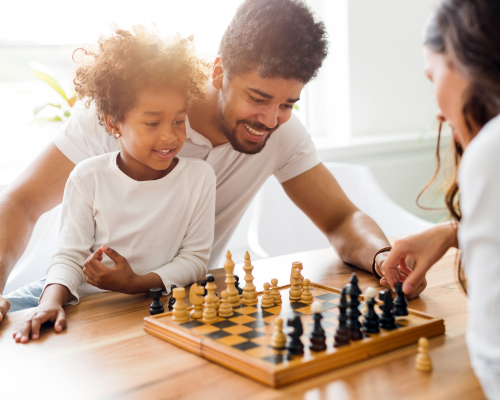
Why chess may be the best brain gym for kids this summer.
Chess is having another moment.
Years after The Queen’s Gambit brought the game back into mainstream conversation, newer documentaries like Queen of Chess and Untold: Chess Mates have kept attention on the drama, brilliance and pressure of the chess world. But for parents, the more useful question is not whether chess is popular again. It is whether the game can actually help kids build skills they will use long after summer is over.
For me, that question became personal during COVID, when routines disappeared and my family, like so many others, was trying to figure out how to keep life moving in a healthy direction. At the time, chess was just another activity for my son. Something to try. No big expectations. But over time, something started to shift.
What began as a simple game slowly became a place where my son could think ahead, make decisions and see the direct results of his choices. There were no shortcuts, no guessing and no one else to blame. Every move mattered and every outcome connected back to a decision he had made.
That is part of what makes chess so powerful for kids. It gives them a safe place to practice thinking.
Why Chess Works Like a Brain Gym
Parents hear a lot about activities that are “good for the brain,” but chess is one of the rare ones where kids are not just absorbing information. They are using their minds in real time.
A child has to focus, remember patterns, manage frustration, look for opportunities and think about what might happen next. Sometimes the move works. Sometimes it does not. Either way, the lesson is immediate. There is no lecture required. The board gives the feedback.
In that sense, chess may be one of the closest things to a brain gym for kids. It asks them to slow down, pay attention and make decisions under pressure. These are not just chess skills. They are life skills.
For many OC parents, especially during summer, that can feel like a missing piece. The school year has structure built in. Summer often does not. Days get looser. Screens become more tempting. Parents want their kids to relax, of course, but they also want activities that help them grow.
Chess can fit into that space because it does not feel like homework.
It is a game. Kids can play it in person, online, at camp, with a friend, with a parent or even for 10 minutes between other activities. It can be serious if a child wants it to be serious, but it does not have to start that way.
What Kids Learn Beyond the Board
One of the biggest gifts chess can give a child is confidence. Not loud confidence. Not the kind that comes from being told they are great. A quieter kind of confidence that comes from seeing improvement happen.
For my son, chess helped build confidence because improvement became visible. He could see himself getting better. He could look back and understand that effort had made a difference.
That is an important lesson for any child. It teaches them that hard things are not automatically out of reach. They may just require practice, patience and a willingness to think a little differently next time.
Chess also helps children practice decision making in a way few activities do. Every move is a choice. Some choices are obvious. Others are uncertain. A child has to learn to sit with that uncertainty and still decide. That is a skill many adults are still trying to master.
It also teaches kids how to lose. That may not sound like a selling point, but it is. Losing a chess game is clear. The game ends, the result is there and the child has to decide what to do with it. They can quit. They can get angry. Or they can ask what they missed and try again.
That kind of resilience is hard to teach directly. Chess gives kids a way to experience it.
How Parents Can Introduce Chess Without Pressure
Parents do not sign a child up for piano because they expect the next great concert pianist. They do it because music teaches discipline, listening, expression and practice. Parents do not put a child in soccer because they assume a professional career is coming. They do it because sports can teach teamwork, effort and resilience.
Chess deserves to be viewed in the same way. For parents who want to introduce chess this summer, the best approach is usually the simplest one.
Start casually. A board on the table is enough. A short online lesson is enough. A few games with a parent or grandparent can be enough. The goal is not to turn chess into another high-pressure activity. The goal is to create an opening.
Let kids be curious before asking them to be good. If a child shows interest, build from there. A local club, camp, school program, online platform or casual tournament can help. But the first step should feel light. Chess works best when kids feel ownership over it.
Let Summer Be the Starting Point
Summer does not have to be perfectly structured to be meaningful. For many families, the best activities are the ones that can fit into real life. A chessboard on the kitchen table. A quick game before bed. A puzzle during a quiet afternoon. A local club if a child wants more. An online game while traveling.
The point is not to force chess. The point is to make room for it.
For families looking for something meaningful this summer, the best activity may not be the loudest, flashiest or newest option.
Sometimes, it just looks like a game.
Dan Shapiro is the author of Decoding Genius: The Unexpected Lessons of After-School Chess Club (coming summer 2026). After seeing how chess helped his son build confidence and decision-making skills during COVID, he set out to better understand the mindset behind the game and what it can teach kids beyond the board. decodinggeniusbook.com





Leave a Reply
You must be logged in to post a comment.